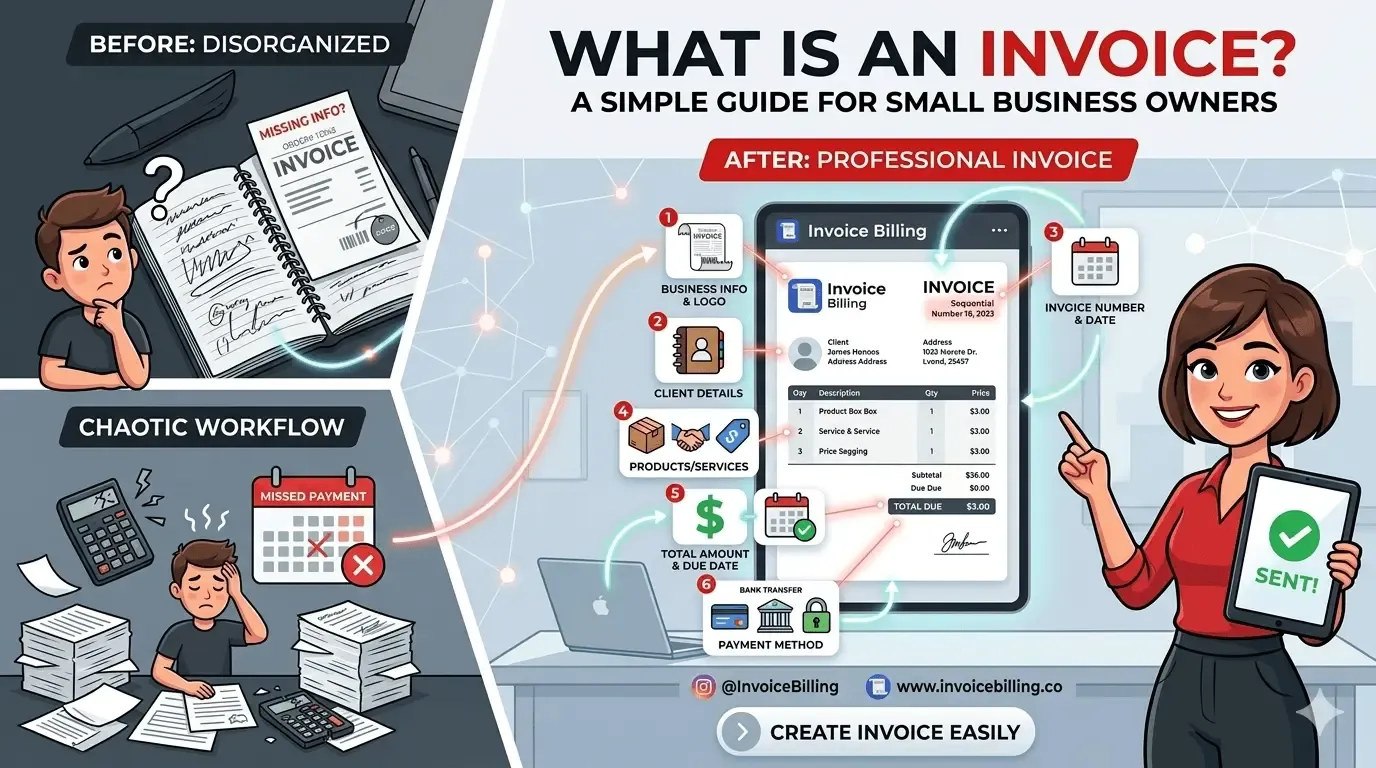
Quick answer: An invoice is a document a business sends to a customer to request payment for goods or services. It lists what was provided, how much it costs, and when payment is due. An invoice also serves as an official record of the sale, which helps both you and your customer with bookkeeping and taxes.
Introduction
If you've just started a business or taken on your first freelance client, you'll quickly hear the word "invoice." A client might ask, "Can you send me an invoice?" or your accountant might ask where your invoices are kept.
It sounds formal, but the idea is simple. An invoice is how you tell a customer, clearly and professionally, what they owe you. Get it right, and you'll be paid faster, keep tidy records, and look like the professional you are.
This guide explains what an invoice is, why it matters, what it should include, the main types you'll come across, and how invoices differ from receipts, bills, and estimates.
What Is an Invoice?
An invoice is a written request for payment. A seller sends it to a buyer after providing goods or services, or when a payment is due under an agreement.
A typical invoice tells the customer:
- Who is asking for payment (your business)
- Who needs to pay (the customer)
- What was provided
- How much it costs
- When and how to pay
An invoice does two jobs at once. For your customer, it's a request to pay. For both of you, it's a record of the transaction that can be used for accounting, tax returns, and resolving any disagreements later.
Why Are Invoices Important?
Invoices might seem like paperwork, but they're essential to running a healthy business:
- They get you paid. A clear invoice with a due date makes it easy for customers to pay on time.
- They keep your records organized. Every invoice is a record of income you can refer back to.
- They provide proof of a transaction. If there's ever a dispute, your invoice shows what was agreed and delivered.
- They make tax time easier. Invoices help you and your accountant track income and taxes.
- They make you look professional. A well-presented invoice builds trust and encourages repeat business.
- They help with cash flow. Knowing what's been invoiced and what's still unpaid helps you plan.
We explore the trust side further in why professional invoices build more client trust than simple bills.
What Should an Invoice Include?
Most invoices include these essentials:
- The word "Invoice" clearly at the top
- Your business details: name, address, contact information, and logo
- Your customer's details: name, company, and billing address
- A unique invoice number for tracking
- The invoice date and due date
- A description of the goods or services with quantities and prices
- Taxes and discounts, if any
- The total amount due
- Payment terms and methods, such as bank transfer details
Some countries require extra details, such as a tax registration number. If you're unsure, check with a local accountant or your tax authority.
For a step-by-step walkthrough with an example, read how to create a professional invoice in minutes.
Common Types of Invoices
Not every invoice is the same. Here are the types small businesses come across most:
| Type | What it's for |
|---|---|
| Standard invoice | The everyday invoice for completed work or delivered goods |
| Pro forma invoice | A preliminary invoice sent before work or delivery, showing expected costs. It isn't a demand for payment |
| Interim (progress) invoice | Bills part of a large project at agreed milestones |
| Final invoice | Bills the remaining balance once a project is finished |
| Recurring invoice | Sent regularly for ongoing services, such as a monthly retainer |
| Credit note | Reduces or cancels an amount on an earlier invoice, for example after a refund or correction |
| Commercial invoice | Used when shipping goods internationally, mainly for customs |
Most freelancers and small businesses mainly use standard, interim, and recurring invoices. If a client pays only part of an invoice, here's how to handle partial payments on an invoice.
Invoice vs Receipt vs Bill vs Estimate
These terms often get mixed up. Here's the difference:
| Document | Who sends it | When | Purpose |
|---|---|---|---|
| Estimate | Seller | Before work | Shows likely cost |
| Invoice | Seller | After work or when payment is due | Requests payment |
| Bill | (Same as an invoice, seen from the buyer's side) | When payment is due | What the customer owes |
| Receipt | Seller | After payment | Confirms payment was received |
In everyday language, people often say "bill" when they mean "invoice." The key distinction to remember is this: an invoice asks for payment, and a receipt confirms it.
For a closer look at estimates, read invoice vs estimate: what's the difference.
Common Payment Terms Explained
You'll often see short phrases at the bottom of invoices. Here's what the most common ones mean:
- Due on receipt: payment is expected as soon as the invoice arrives
- Net 7 / Net 15 / Net 30: payment is due within 7, 15, or 30 days of the invoice date
- End of month (EOM): payment is due at the end of the month the invoice is issued
- 50% upfront: half is paid before work starts, the rest on completion
- Late fee: an extra charge if payment arrives after the due date (check local rules on what's allowed)
Shorter terms usually mean faster payment. Whatever you choose, state it clearly on every invoice.
When Should You Send an Invoice?
Send an invoice:
- As soon as a job is finished or goods are delivered
- At agreed milestones on larger projects
- Before work starts, if you've agreed on a deposit
- On a regular schedule for ongoing services
The faster you invoice, the faster you're likely to be paid. Waiting weeks makes your invoice easier for a busy client to forget.
How to Create an Invoice
You have a few options:
- Word or Excel templates: free, but slow, and mistakes are easy to make
- Accounting software: powerful, but often more than a small business needs
- An invoice maker app: quick, simple, and designed for invoicing
With an invoice maker app like Invoice Maker, you can:
- Create quick invoices and estimates in a few taps
- Use Custom Templates with your logo, signature, and stamp
- Export Invoice PDFs ready to send
- Track invoices with Real Time Tracking (viewed, paid, or overdue)
- Send Payment Reminders automatically
- Work with Offline Access when there's no internet
[Screenshot: a completed invoice in the Invoice Maker app]
You may also hear about "e-invoicing," which is different from simply emailing a PDF. Here's the difference between e-invoicing and PDF invoices.
Common Invoice Mistakes to Avoid
- Missing or duplicate invoice numbers, which make tracking difficult
- No due date, so customers don't know when to pay
- Vague descriptions that lead to questions and delays
- Incorrect totals from manual calculation errors
- Sending late, which delays your payment
For more, see 5 common invoicing mistakes small businesses make.
How Long Should You Keep Invoices?
Keep copies of every invoice you send, along with records of payment. Many tax authorities require businesses to keep financial records for several years, often five to seven, but the exact period depends on your country. Ask your accountant or check your local tax authority's guidance.
Storing invoices digitally makes this easy. An invoice app keeps every invoice in one place, so you can find any of them in seconds.
Frequently Asked Questions
What is an invoice in simple words?
An invoice is a document asking a customer to pay for goods or services. It shows what was provided, how much it costs, and when payment is due.
What is the difference between an invoice and a receipt?
An invoice requests payment before it's made. A receipt confirms that payment has been received.
Is an invoice the same as a bill?
Mostly, yes. "Invoice" is the seller's term for the payment request, and "bill" is often how the customer refers to it.
Does an invoice need an invoice number?
Yes. A unique invoice number helps you and your customer track payments, and in many countries it's required.
When should I send an invoice?
As soon as the work is finished or goods are delivered, or according to the payment schedule you've agreed.
What does Net 30 mean on an invoice?
It means payment is due within 30 days of the invoice date.
Final Thoughts
An invoice is one of the simplest tools in business, and one of the most important. It tells your customer what they owe, gives you a record of every sale, and helps you get paid on time.
Keep your invoices clear, complete, and consistent, send them promptly, and you'll avoid most payment problems before they start. And if a customer does pay late, here's how to keep track of unpaid invoices and get paid on time.
👉 Create your first invoice in minutes. Download Invoice Maker on the App Store or Google Play.