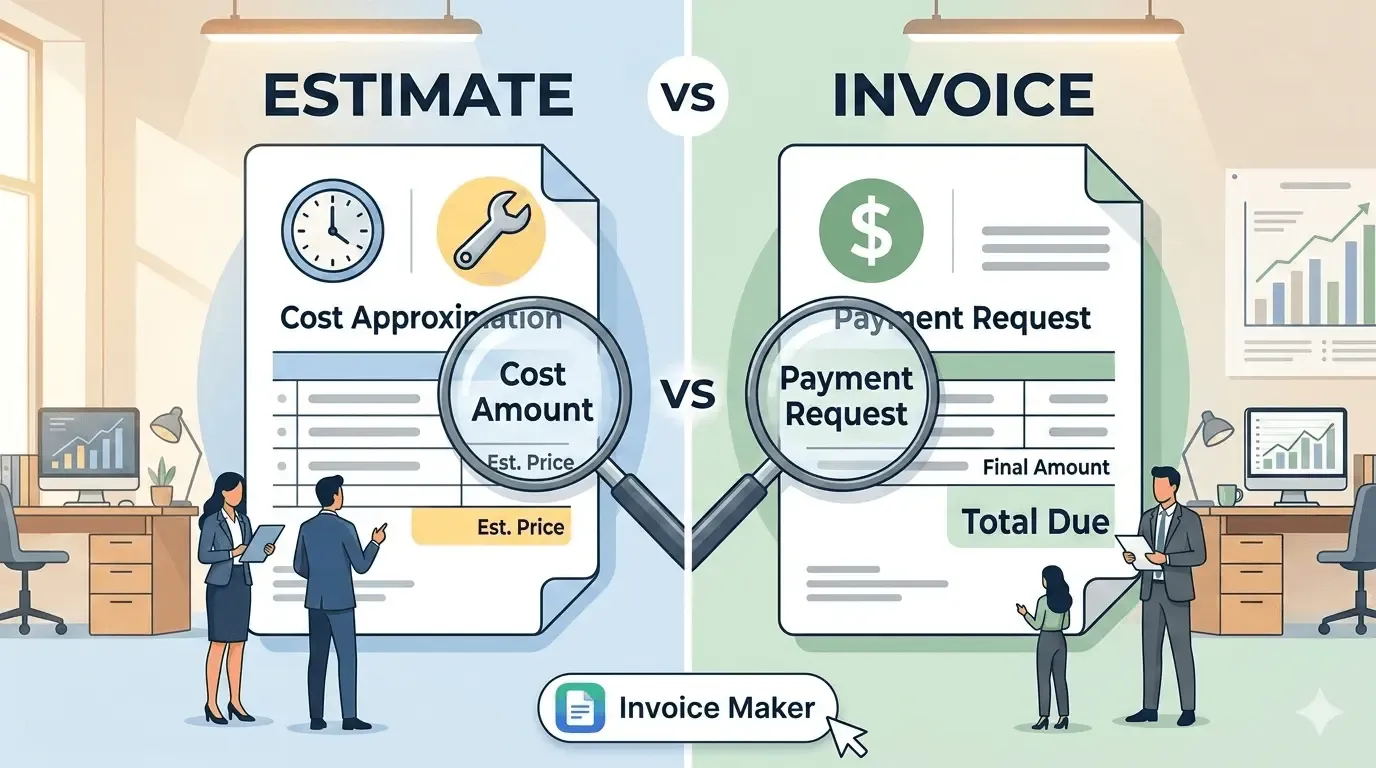
Quick answer: An estimate is sent before work begins and tells a client roughly what a job will cost. It doesn't ask for payment. An invoice is sent after the work is done (or when a payment is due) and asks the client to pay a final amount by a set date. In short: an estimate helps a client decide, and an invoice helps you get paid.
Introduction
A new client emails you: "Can you send me something with the price?" Do you send an estimate or an invoice?
It's a common moment of hesitation for freelancers and small business owners, and the two terms often get used interchangeably. But they do very different jobs. Sending the wrong one can confuse a client, cause awkward conversations about money, or even delay payment.
This guide explains exactly what each document is, when to use it, what to include, and how the two work together from the first quote to the final payment.
What Is an Estimate?
An estimate is a document you send before starting a job. It gives your client an approximate cost so they can decide whether to go ahead.
A good estimate usually includes:
- Your business name, logo, and contact details
- The client's name and contact details
- An estimate number and date
- A description of the work or products
- The estimated cost for each item
- An estimated total
- The project scope and expected timeline
- How long the estimate is valid (for example, 30 days)
An estimate is not a bill. Your client doesn't owe you anything when they receive it. It's an opening step in the conversation: "Here's what I think this will cost. Would you like to proceed?"
Estimate vs quote: is there a difference?
People often use "estimate" and "quote" to mean the same thing, but in many industries there's a small difference. An estimate is an approximate price that may change if the work turns out bigger or smaller than expected. A quote is usually a fixed price for a clearly defined job. If you think costs could change, call it an estimate and say so clearly.
When Should You Send an Estimate?
Send an estimate when:
- A client asks for pricing before agreeing to work with you
- The project scope isn't final and details may still change
- Costs depend on materials or time, like in construction, repairs, or design work
- You're competing for the job and the client is comparing options
- The project is large, and the client needs approval from a manager or budget holder
Estimates build trust. They show the client you're transparent about money from the start, and they reduce the chance of an unpleasant surprise when the invoice arrives.
What Is an Invoice?
An invoice is a request for payment. You send it after you've completed the work, delivered the products, or reached a payment milestone.
A proper invoice includes:
- Your business name, logo, and contact details
- The client's name and billing details
- A unique invoice number
- The invoice date and due date
- An itemized list of products or services
- Taxes or discounts, if any
- The final total due
- Payment terms and accepted payment methods
Unlike an estimate, an invoice is the official record of a sale. It tells the client exactly what they owe and when, and it's the document you'll rely on for your bookkeeping and taxes. For a deeper look at invoices, read what is an invoice? A simple guide for small business owners.
When Should You Send an Invoice?
Send an invoice when:
- The work is finished or the products are delivered
- You've reached a milestone on a larger project
- A deposit is due before you start
- A recurring payment is due, such as a monthly retainer
The sooner you invoice after finishing a job, the sooner you're likely to get paid. Waiting weeks makes it easy for your invoice to slip down a client's to-do list.
Invoice vs Estimate: Key Differences
| Estimate | Invoice | |
|---|---|---|
| Purpose | Shows likely cost | Requests payment |
| When it's sent | Before work begins | After work is done or a payment is due |
| Amount | Approximate | Final and exact |
| Payment required? | No | Yes |
| Has a due date? | No (may have an expiry date) | Yes |
| Can it change? | Yes, if the scope changes | Should only change through a correction |
| Role in your records | Planning and approval | Official record of the sale |
The simplest way to remember it: an estimate starts the job, and an invoice finishes it.
How Estimates and Invoices Work Together
In most projects, you'll use both. Here's a typical flow:
- The client asks for pricing. You send an estimate.
- The client reviews and approves it. You agree on the scope and timeline.
- You complete the work (and update the client if anything changes).
- You send an invoice based on the approved estimate, adjusted for any agreed changes.
- The client pays, and you mark the invoice as paid.
If the final cost ends up different from the estimate, tell your client before you send the invoice. A quick message like "The extra two pages you requested added $200" avoids surprises and keeps the relationship healthy.
On bigger jobs, you might send several invoices against one estimate, for example a deposit, a midpoint payment, and a final balance. If a client pays only part of an invoice, here's how to handle partial payments on an invoice.
A Real-World Example
Imagine you're a freelance web designer.
Estimate (sent March 1):
| Item | Estimated cost |
|---|---|
| Homepage design | $500 |
| 3 inner pages | $600 |
| Contact form setup | $100 |
| Estimated total | $1,200 |
Valid for 30 days. Final cost may change if the scope changes.
The client approves, then asks for one extra page partway through. You agree on $200 for it.
Invoice (sent April 10):
| Item | Amount |
|---|---|
| Homepage design | $500 |
| 4 inner pages | $800 |
| Contact form setup | $100 |
| Total due | $1,400 |
Invoice INV-031 · Due April 24 · Payment by bank transfer
Because the client approved the extra page in advance, the higher invoice total is no surprise, and payment goes through smoothly.
Common Mistakes to Avoid
- Sending an invoice when the client asked for a price. It can feel pushy and confuse the client.
- Calling an estimate a quote when the price might change.
- Leaving out an expiry date on estimates, so old prices get held against you months later.
- Invoicing more than the estimate without warning. Always explain changes first.
- Not linking the two. Mention the estimate number on your invoice so the client can match them.
For more pitfalls, see 5 common invoicing mistakes small businesses make.
How an Invoice Maker App Simplifies Both
Creating estimates and invoices by hand in Word or Excel is slow, and it's easy to copy the wrong number from one to the other. An invoice maker app keeps everything in one place:
- Quick invoices and estimates: create either in just a few taps
- Turn an estimate into an invoice once the client approves, without retyping
- Custom Templates with your logo, signature, and stamp, so both documents look consistent
- Invoice PDFs that are ready to send
- Client Management: saved client details and payment history
- Real Time Tracking to see when an invoice is viewed, paid, or overdue
- Payment Reminders for invoices that aren't paid on time
Want step-by-step help? Read how to create a professional invoice in minutes.
[Screenshot: converting an approved estimate into an invoice]
Frequently Asked Questions
What is the main difference between an invoice and an estimate?
An estimate shows the likely cost before work begins and doesn't require payment. An invoice requests payment for completed work and shows the final amount due.
Is an estimate legally binding?
Generally, an estimate is an approximation rather than a binding price, but rules vary by country and industry. If you need a fixed, agreed price, use a written quote or contract, and check local rules if you're unsure.
Can the final invoice be higher than the estimate?
Yes, if the scope changes. Always tell your client and get their agreement before invoicing more than the estimate.
Do I need to send an estimate before every invoice?
No. Small or routine jobs with fixed prices often go straight to an invoice. Estimates are most useful for new clients, bigger projects, or work where costs may change.
Is a quote the same as an estimate?
They're often used interchangeably, but a quote usually means a fixed price, while an estimate is an approximate price that may change.
Can I create estimates and invoices on my phone?
Yes. The Invoice Maker app lets you create both on iPhone and Android, even offline.
Final Thoughts
Estimates and invoices are two halves of the same process. The estimate sets expectations before you start, and the invoice secures payment once you're done. Using each at the right time makes you look more professional, prevents misunderstandings, and helps you get paid without awkward conversations.
Keep both clear, consistent, and connected, and your clients will always know where they stand. And if a client is slow to pay that final invoice, here are some tips on how to get clients to pay invoices faster without sounding pushy.
👉 Create estimates and invoices in seconds. Download Invoice Maker on the App Store or Google Play.