Unpaid invoices are one of the most common challenges faced by freelancers, contractors, small businesses, and service providers. You complete the work, send the invoice, and expect payment by the due date. However, the due date passes, and the payment still has not arrived.
Sometimes the client simply forgot. In other cases, the invoice may be sitting in the wrong inbox, waiting for approval, or missing information the client needs before processing payment. Whatever the reason, unpaid invoices can quickly affect your cash flow and make it harder to manage everyday business expenses.
The good news is that keeping track of unpaid invoices does not have to be complicated. With a clear invoicing process, regular payment tracking, and timely reminders, you can stay organized and improve your chances of getting paid on time.
This guide explains how to track unpaid invoices, follow up professionally, and build a simple system that helps you manage payments more efficiently.
What Is an Unpaid Invoice?
An unpaid invoice is any invoice that has been sent to a client but has not yet been paid.
Not every unpaid invoice is overdue.
For example, if you send an invoice with a payment term of 15 days, the invoice remains unpaid until the client makes the payment. However, it only becomes overdue once the 15-day payment deadline has passed.
Understanding the difference between unpaid and overdue invoices is important because it helps you organize your payment follow-up process.
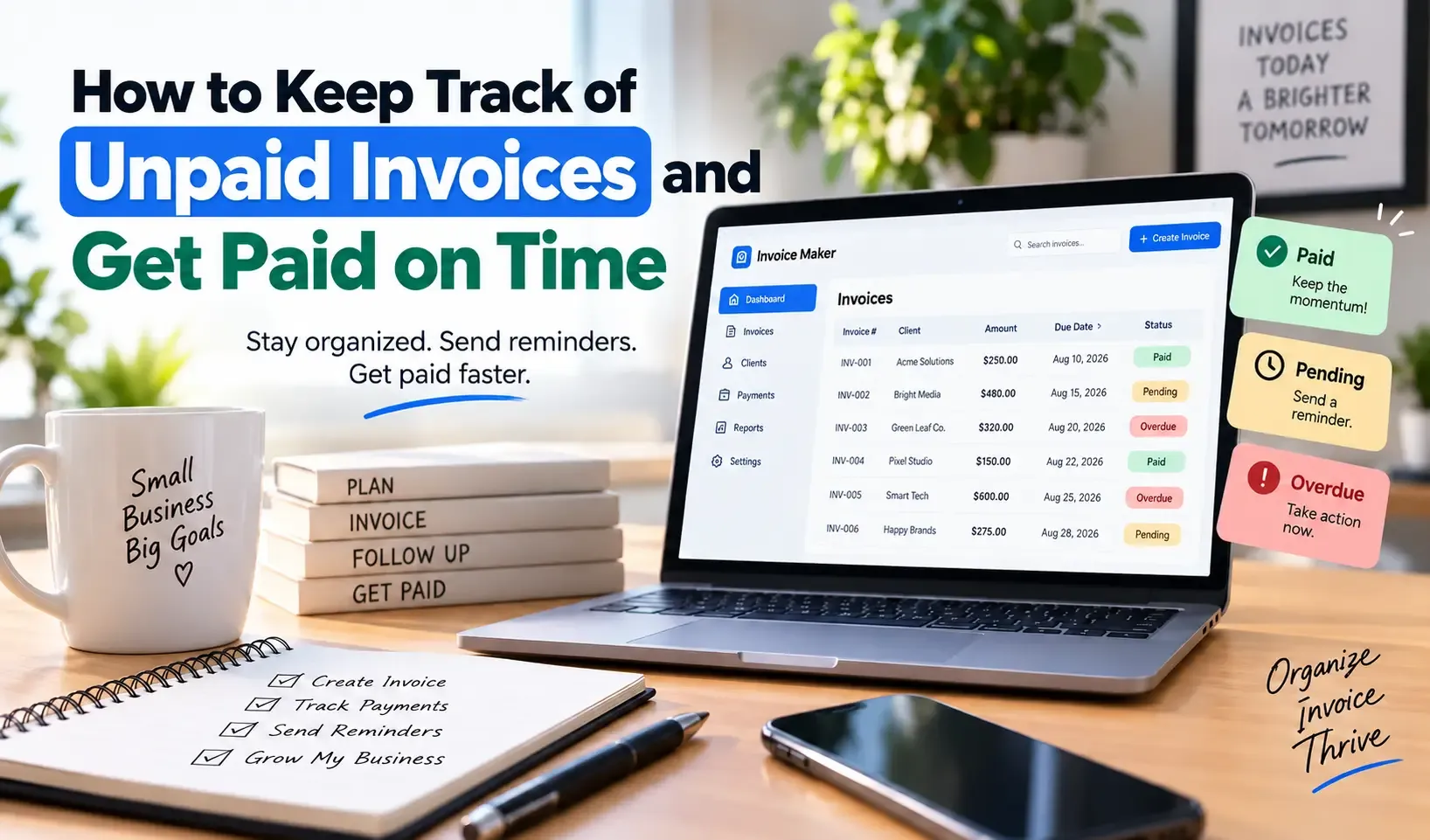
You can generally divide invoices into four categories:
- Draft: The invoice has been created but has not yet been sent.
- Sent or pending: The client has received the invoice, but payment has not been received.
- Paid: The invoice has been successfully paid.
- Overdue: The payment deadline has passed, and the invoice remains unpaid.
Keeping these statuses organized makes it much easier to see which clients need a reminder and which payments are expected soon. A clear tracking process also helps businesses identify outstanding balances before they become serious cash-flow problems.
Why Tracking Unpaid Invoices Is Important
When you do not regularly track unpaid invoices, it is easy for payments to slip through the cracks.
You may assume a client has already paid, forget about an invoice after sending it, or realize too late that several invoices are overdue. Over time, these small issues can create larger cash-flow problems.
Tracking outstanding invoices helps you:
- Know exactly how much money is still owed to your business.
- Identify invoices that are approaching their due dates.
- Follow up with clients at the right time.
- Reduce the risk of forgetting overdue payments.
- Maintain accurate financial records.
- Better understand your expected cash flow.
A structured follow-up process can also help protect client relationships. Instead of sending random reminders whenever you remember, you can follow a consistent and professional payment process. Regular tracking and timely reminders are widely recommended as key parts of managing outstanding invoices.
1. Create Clear and Professional Invoices
The best way to reduce payment problems is to start with a clear invoice.
A confusing invoice can delay payment because the client may not understand what they are being charged for, when the payment is due, or how to make the payment.
Every professional invoice should clearly include:
- Your business name and contact information.
- The client's name and billing information.
- A unique invoice number.
- The invoice issue date.
- A clear payment due date.
- A description of the products or services provided.
- The quantity and price of each item.
- The total amount due.
- Applicable taxes or additional charges.
- Accepted payment methods.
- Any relevant payment terms.
Avoid vague descriptions such as "Services Provided."
Instead, clearly describe the work or products included in the invoice. For example:
Website design services – August 2026
or
Social media management – Monthly service package
Clear invoices reduce unnecessary questions and make it easier for clients to approve and process payments. Invoice guidance commonly emphasizes clear business details, customer information, itemized descriptions, and visible payment terms to reduce payment friction.
For a full checklist and sample invoice, see how to create a professional invoice in minutes.
2. Set Clear Payment Terms Before Starting Work
Payment expectations should not be a surprise when the invoice arrives.
Before starting a project, discuss payment terms with your client and include them in your proposal, agreement, or contract where appropriate.
Your payment terms may include:
- Payment due upon receipt.
- Payment due within 7 days.
- Net 15 payment terms.
- Net 30 payment terms.
- A deposit before work begins.
- Milestone payments for larger projects.
- A late payment policy.
For example:
Payment is due within 15 days of the invoice date.
Simple and clear terms reduce confusion. They also give you a reference point when following up on overdue payments.
For larger projects, requesting a deposit or dividing the project into milestone payments can reduce the amount of money left unpaid at the end of the project. Clear payment expectations before work begins are an important part of preventing payment delays.
3. Keep All Invoice Information in One Place
One of the easiest ways to lose track of unpaid invoices is to manage them across multiple locations.
For example, you might create invoices in one application, save PDFs in a folder, track payments in a spreadsheet, and search through emails to find client conversations.
This can become difficult as your business grows.
Instead, try to keep your invoice records organized in one central system.
For every invoice, you should be able to quickly see:
- Invoice number.
- Client name.
- Invoice amount.
- Invoice date.
- Payment due date.
- Current payment status.
- Payment date, if paid.
- Remaining balance.
An invoice maker app can simplify this process by allowing you to create invoices and monitor their status from one place.
Instead of manually searching through old emails or folders, you can quickly review which invoices are paid, pending, or overdue.
4. Check Outstanding Invoices Regularly
Do not wait until the end of the month to check whether clients have paid.
Make invoice tracking part of your regular business routine.
For many small businesses, reviewing unpaid invoices once or twice per week is enough to catch potential problems early. If you send a large number of invoices, you may need to review payment statuses more frequently.
During your review, ask:
- Which invoices are due soon?
- Which invoices are due today?
- Which invoices have become overdue?
- Which clients have a history of late payments?
- Are there invoices that require personal follow-up?
Regular reviews help you act before an invoice becomes seriously overdue.
For example, if an invoice is due in three days, you can send a friendly reminder before the deadline rather than waiting several weeks after the payment becomes overdue.
A structured review process combined with consistent reminders helps businesses avoid letting outstanding balances go unnoticed.
5. Send a Friendly Reminder Before the Due Date
You do not need to wait until an invoice is overdue before contacting your client.
A short and friendly reminder a few days before the due date can help prevent late payment.
For example:
Subject: Reminder: Invoice #1042 Due Soon
Hi [Client Name],
Just a quick reminder that invoice #1042 for [Amount] is due on [Due Date].
Please let me know if you have any questions or need another copy of the invoice.
Thank you!
Best regards,
[Your Name]
The purpose of this reminder is not to pressure the client. It simply helps keep the payment deadline visible.
A practical reminder sequence often starts a few days before the due date, followed by a due-date reminder and progressively firmer follow-ups only when necessary.
6. Follow Up Quickly When an Invoice Becomes Overdue
If the due date passes and payment has not been received, follow up promptly.
Do not assume the client is intentionally avoiding payment.
There may be a simple reason for the delay. For example:
- The invoice was missed.
- The invoice was sent to the wrong person.
- The payment requires internal approval.
- The client needs another copy.
- There is a question about the invoice.
- The payment process has been delayed.
Start with a polite and professional message.
Example overdue invoice reminder
Subject: Payment Reminder: Invoice #1042
Hi [Client Name],
I hope you are doing well.
This is a quick reminder that invoice #1042 for [Amount] was due on [Due Date] and is currently outstanding.
Please let me know if the payment has already been processed or if there is anything you need from me to complete the payment.
Thank you,
[Your Name]
Keep the first follow-up professional and factual. Include the invoice number, amount, original due date, and a clear way for the client to respond or pay. These details reduce friction and make it easier for the client to take action.
7. Use a Consistent Payment Reminder Schedule
One of the biggest mistakes businesses make is following up inconsistently.
You might remember to contact one client after three days but forget another invoice for several weeks.
Creating a simple reminder schedule solves this problem.
A practical schedule could look like this:
3 to 5 Days Before the Due Date
Send a friendly reminder.
Goal: Help the client remember the upcoming payment.
On the Due Date
Send a short payment reminder.
Goal: Confirm that payment is now due.
1 to 7 Days Overdue
Send a polite follow-up.
Goal: Find out whether there is a problem or delay.
14 to 30 Days Overdue
Send a firmer reminder.
Goal: Request a specific payment date and restate your payment terms.
30+ Days Overdue
Consider a more direct follow-up.
Depending on your business agreement and local laws, this may involve a final notice, late fees where valid and previously agreed, a payment plan, or professional advice about further collection options.
The key is to remain professional while gradually increasing the urgency of your communication. Payment reminder guidance consistently recommends a staged approach rather than starting with an aggressive message.
8. Make It Easy for Clients to Pay
Sometimes payment is delayed because the payment process itself is inconvenient.
If your invoice does not clearly explain how to pay, the client may need to email you for payment details or search through previous messages.
Make the payment process as simple as possible.
Clearly include:
- Accepted payment methods.
- Bank transfer details where appropriate.
- Online payment options.
- Payment links, if available.
- Any reference number the client needs.
The fewer steps a client needs to take, the easier it is for them to complete payment.
Every payment reminder should also make the next action clear. The client should immediately know what invoice is being discussed, how much is due, and what they need to do next.
9. Keep Communication Professional and Friendly
Following up on unpaid invoices can sometimes feel uncomfortable, especially when working with long-term clients.
However, asking for payment is a normal part of running a business.
You completed the agreed work or delivered the product. The invoice represents the payment that is due.
Try to avoid apologizing excessively for sending reminders. At the same time, avoid aggressive language early in the process.
A good approach is:
Friendly before the due date.
Polite and direct shortly after the due date.
Firm and specific when the invoice remains unpaid for an extended period.
If a client has a legitimate problem, listen and try to understand the situation. In some cases, agreeing on a payment date or payment plan may be more productive than repeatedly sending the same reminder.
Professional communication can help you collect payments while preserving valuable business relationships.
10. Use an Invoice Maker to Simplify Payment Tracking
As your business grows, manually tracking invoices can become time-consuming.
Spreadsheets can work for a small number of invoices, but they require constant updates and can become difficult to manage.
An invoice maker can simplify the entire process by helping you:
- Create professional invoices.
- Save client information.
- Organize invoice records.
- Track paid and unpaid invoices.
- Monitor overdue payments.
- Review payment history.
- Keep business documents organized.
Having a clear overview of your invoices allows you to quickly identify payments that need attention.
Instead of wondering whether a client has paid, you can review the invoice status and take the appropriate next step.
A digital invoicing workflow can also help businesses stay more consistent with sending invoices, monitoring payment status, and following up when action is required.
Frequently Asked Questions
How do I keep track of unpaid invoices?
The easiest way is to maintain a central invoice tracking system that shows the invoice number, client name, amount, due date, and payment status. Review outstanding invoices regularly and follow up when payments approach or pass their due dates.
How often should I check unpaid invoices?
Small businesses should generally review outstanding invoices at least once a week. Businesses that send many invoices may need to review them more frequently.
When should I send a payment reminder?
A friendly reminder can be sent a few days before the due date. You can send another reminder on the due date and follow up shortly after the invoice becomes overdue.
What should I include in an overdue invoice reminder?
Include the invoice number, amount due, original due date, and clear payment instructions. Also provide a way for the client to contact you if there is a question or problem.
How can I get clients to pay invoices faster?
Send clear invoices promptly, set payment terms before starting work, make payment easy, track invoice status regularly, and send consistent payment reminders.
What should I do if a client does not pay an invoice?
Start with polite reminders and gradually increase the firmness of your follow-up. If the invoice remains unpaid, review your contract and payment terms and consider appropriate next steps based on the amount involved and applicable laws.
Final Thoughts
Keeping track of unpaid invoices is not just about chasing late payments. It is about creating a reliable system that helps your business stay organized and maintain healthy cash flow.
Start by sending clear invoices with visible payment terms. Keep all invoice information organized, review unpaid payments regularly, and send reminders before and after the due date.
Most importantly, do not wait too long to follow up.
A simple, consistent payment process makes it easier to identify unpaid invoices, communicate professionally with clients, and reduce the number of payments that become seriously overdue.
With the right invoicing system, you can spend less time searching for unpaid invoices and more time focusing on growing your business.
👉 Start creating professional invoices today and take control of your payments.