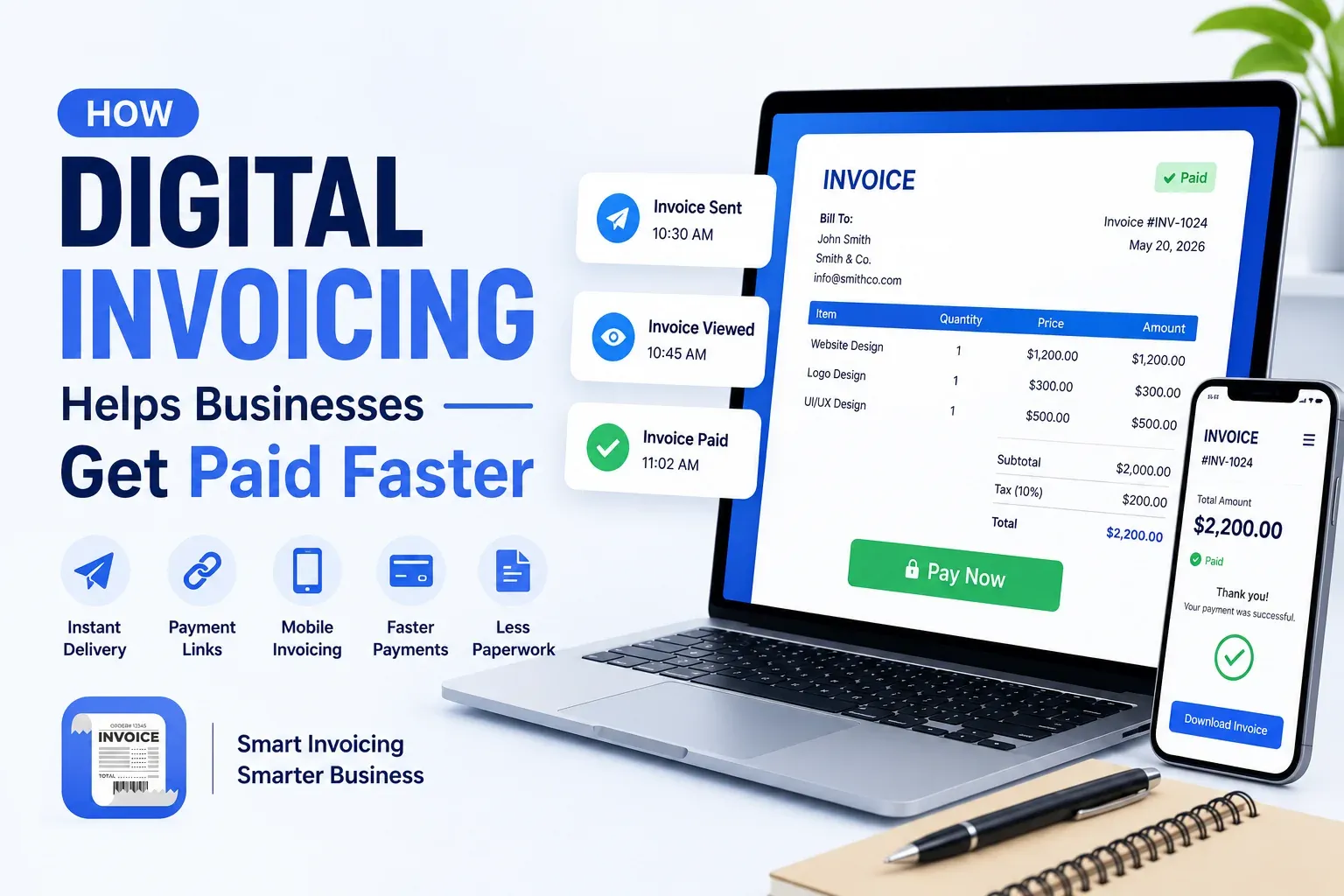
For many small businesses, freelancers, and entrepreneurs, getting paid on time is one of the biggest challenges. Surprisingly, late payments aren't always caused by customers refusing to pay. More often, delays happen because invoices are sent manually, misplaced in crowded inboxes, or require unnecessary steps before payment can be completed.
This is where digital invoicing changes everything.
By replacing paper invoices and manual processes with fast, automated solutions, businesses can send invoices instantly, accept online payments, and track every stage of the billing process. The result is faster payments, healthier cash flow, and less time spent chasing unpaid invoices.
In this guide, we'll explore how digital invoicing helps businesses get paid faster and why it's becoming the preferred billing method for companies of every size.
What Is Digital Invoicing?
Digital invoicing is the process of creating, sending, tracking, and managing invoices electronically instead of using paper documents or manually created PDFs. It allows businesses to deliver invoices instantly, monitor payment status, and often accept payments directly through secure online payment options.
Unlike traditional invoicing methods, electronic invoices simplify the entire payment process. Rather than printing, mailing, or manually emailing invoices, businesses can generate professional invoices in seconds and send them through multiple digital channels.
This not only saves time but also significantly reduces delays that often slow down payments.
Why Businesses Get Paid Faster With Digital Invoicing
The biggest advantage of digital invoicing is that it removes friction at every stage of the payment journey.
From creating an invoice to receiving payment, every step becomes faster, easier, and more transparent.
Instead of waiting days for invoices to be delivered or manually processed, businesses can instantly send invoices, provide one-click payment options, track customer activity, and receive payments without unnecessary delays.
Several key features make this possible:
- Instant invoice delivery
- Easy invoice sharing
- Built-in payment links
- Mobile invoicing
- Better customer experience
- Reduced paperwork and manual errors
Let's look at each of these in more detail.
Faster Delivery Means Faster Payments
Traditional invoicing often introduces delays before customers even receive the invoice.
Paper invoices may take several days to arrive by mail, while manually sending PDF attachments requires additional administrative work.
Digital invoicing eliminates this first bottleneck.
Invoices can be generated and delivered instantly through email, secure links, or integrated business platforms. Customers receive invoices within seconds, allowing them to review and approve payments immediately.
Even saving a single day during invoice delivery can shorten the overall payment cycle.
For businesses sending dozens or hundreds of invoices every month, this improvement can significantly increase faster invoice payments and improve overall cash flow.
Instant Sharing Across Multiple Channels
Modern businesses communicate through more than just email.
Customers often prefer receiving documents through WhatsApp, SMS, messaging platforms, or secure customer portals.
Digital invoicing supports multiple sharing options, making it easier to deliver invoices to the right person without delays.
Instead of wondering whether an invoice was buried in someone's inbox, businesses can quickly resend invoices using another communication channel.
Sharing options commonly include:
- Secure invoice links
- SMS
- Customer portals
- Cloud storage links
Because invoices are easier to access, customers are more likely to review and pay them promptly.
Payment Links Remove the Biggest Barrier
One of the most powerful features of digital billing is integrated payment links.
Instead of asking customers to copy bank details or write checks manually, digital invoices include a convenient "Pay Now" button.
With one click, customers can complete payments using their preferred payment method.
Supported payment methods often include:
- Credit cards
- Debit cards
- Bank transfers
- Apple Pay
- Google Pay
- Digital wallets
Reducing the number of steps required to complete payment has a measurable impact on payment speed.
The easier it is to pay, the sooner customers complete the transaction.
For many businesses, embedded payment links are one of the biggest reasons they experience faster invoice payments after switching to digital invoicing.
Mobile Invoicing Keeps Business Moving
Business doesn't always happen behind a desk.
Contractors, freelancers, consultants, photographers, plumbers, electricians, delivery services, and sales professionals often need to invoice customers immediately after completing work.
Mobile invoicing allows businesses to:
- Create invoices on-site
- Send invoices instantly
- Track payment status
- Receive payment notifications
- Manage customer information
Instead of waiting until returning to the office, invoices reach customers while the service is still fresh in their minds.
Many invoicing apps also notify businesses when customers:
- Open the invoice
- View payment details
- Complete payment
This visibility makes follow-ups more effective and eliminates guesswork.
Better Customer Convenience Leads to Faster Payments
Customers appreciate simple experiences.
A clear, professional invoice with straightforward payment instructions encourages quicker action.
Digital invoices are designed for convenience.
They display:
- Itemized charges
- Taxes
- Payment terms
- Due dates
- Contact information
- Payment buttons
Everything customers need is presented clearly in one place.
Because invoices are optimized for desktops, tablets, and smartphones, customers can review and pay them whenever it's convenient.
This level of convenience reduces common payment excuses like:
- "I couldn't open the attachment."
- "I didn't receive the invoice."
- "I wasn't sure how to pay."
The easier you make payment, the faster your customers respond.
Reduced Paperwork Saves Time and Prevents Errors
Paper invoicing creates unnecessary administrative work.
Businesses often spend hours:
- Printing invoices
- Filing paperwork
- Entering invoice information manually
- Correcting data entry mistakes
- Searching for lost documents
Digital invoicing automates much of this process.
Invoices are stored securely online and organized automatically.
Many systems also integrate with accounting software, eliminating duplicate data entry.
The benefits include:
- Fewer mistakes
- Less paperwork
- Better organization
- Faster record retrieval
- Improved compliance
Digital workflows also reduce paper waste, making invoicing both more efficient and environmentally friendly.
Digital Invoicing vs. Traditional Invoicing
While both methods serve the same purpose, digital invoicing offers clear advantages in speed, convenience, and efficiency.
| Feature | Traditional Invoicing | Digital Invoicing |
|---|---|---|
| Delivery | Postal mail or manual email | Instant online delivery |
| Payment Methods | Cash, checks, bank transfer | Cards, bank transfer, digital wallets, payment links |
| Tracking | None | Real-time status updates |
| Error Rate | Higher | Lower through automation |
| Paperwork | High | Minimal |
| Average Payment Time | Several days to weeks | Often significantly faster |
By reducing delays and manual work, digital invoicing helps businesses improve cash flow while delivering a better customer experience.
How to Get Started With Digital Invoicing
Switching to digital invoicing is easier than many businesses expect.
Start by choosing an invoicing platform that allows you to:
- Create professional invoices
- Add company branding
- Accept online payments
- Generate payment links
- Track invoice status
- Send automatic reminders
Next, import your customer information and begin sending invoices electronically.
If you're transitioning from paper invoices, let your customers know they'll now receive invoices digitally and explain the benefits, such as quicker delivery and more convenient payment options.
Once your workflow is established, you'll spend less time on administration and more time growing your business.
Frequently Asked Questions
Is digital invoicing secure?
Yes. Most digital invoicing platforms use encryption, secure cloud storage, and protected payment gateways to keep invoice data and customer information safe.
How much faster is digital invoicing compared to paper invoices?
Digital invoices are delivered instantly, while paper invoices may take several days to arrive. Combined with online payment options, many businesses receive payments significantly faster after switching to digital invoicing.
Can small businesses use digital invoicing for free?
Yes. Many invoicing platforms offer free plans with essential features such as invoice creation, online sharing, and basic payment tracking. Premium plans provide advanced automation and reporting.
Do customers need an account to pay a digital invoice?
Not always. Many digital invoicing systems allow customers to pay directly using secure payment links without creating an account, making the payment process quick and convenient.
Conclusion
Getting paid quickly isn't just about sending invoices—it's about making the payment process as simple as possible.
Digital invoicing helps businesses eliminate delays by providing instant delivery, flexible sharing options, secure payment links, mobile invoicing, and automated tracking. These improvements reduce administrative work, enhance customer convenience, and accelerate cash flow.
Whether you're a freelancer, startup, or established business, adopting digital invoicing is one of the easiest ways to streamline billing and improve payment speed.
Ready to get paid faster? Start using digital invoicing today and experience a smarter, faster, and more efficient way to manage your business payments.
Download Here:
Apple Store Invoice App
Google Play Invoice App